

Silent Snack
Tranquility is easy to find but hard to choose

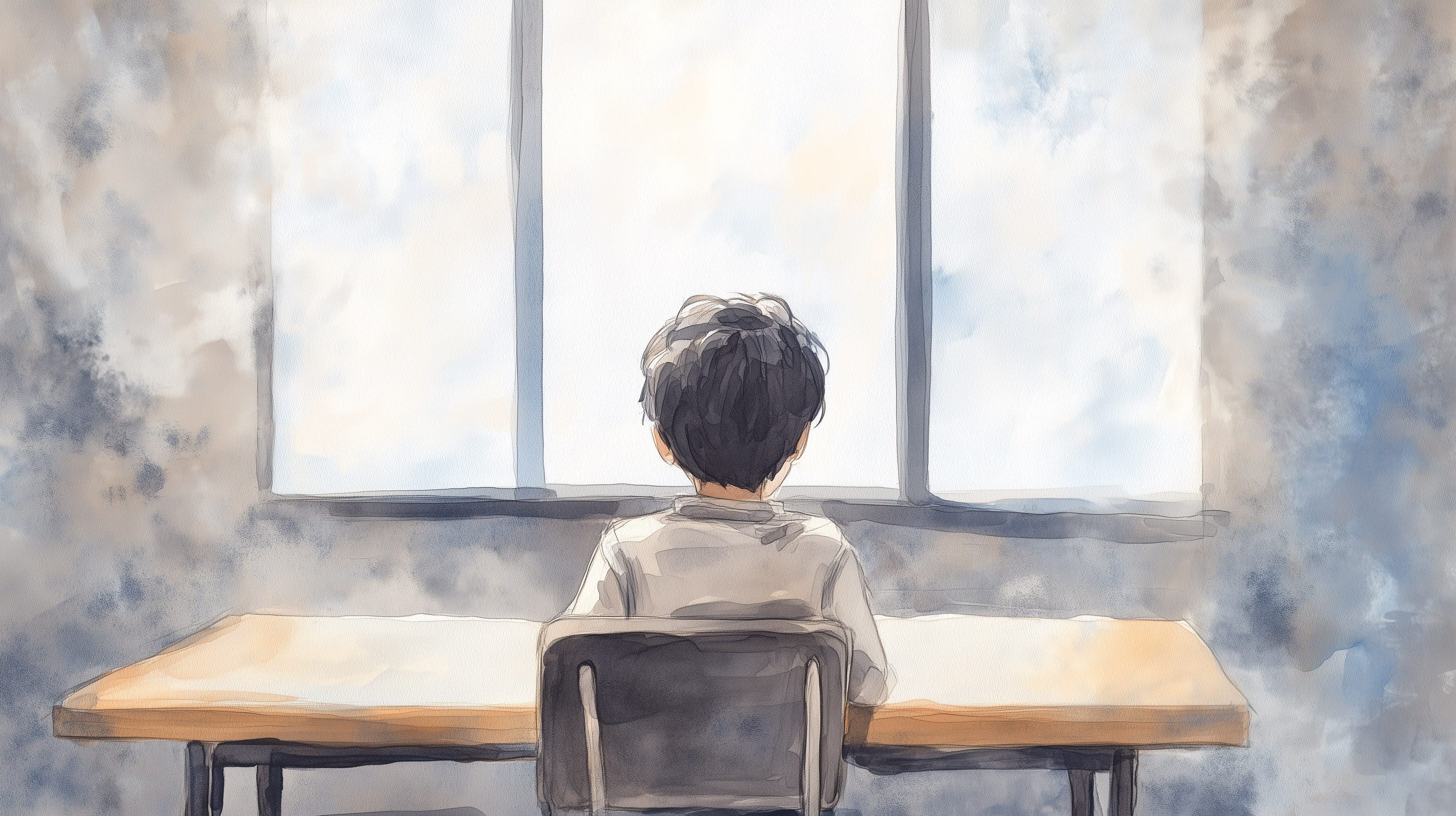
There are tracts in my life that are bare and silent.
They are the open spaces where my busy days had their light and air.
– Rabindranath Tagore, “Stray Birds”
When I was in fourth grade, I often got in trouble for talking in class. Since this was back in the days of chalkboards, the first disciplinary consequence was having one’s name written on the board. Subsequent infractions earned check-marks. After three of these, you received a harsher punishment: you had to spend snack time – the 10-minute afternoon break – sitting silent and alone by the window.
I was pretty good at gaming the system, so I only got silent snack once. But I remember it vividly. As I sat by myself, with the din of the classroom behind me, I gazed out the window and felt … peaceful. It was so pleasant, I recall thinking I would enjoy doing it more often, even without being forced to.
I didn’t, of course. At eight years old, deliberately choosing tranquil solitude over social interaction didn’t feel worth the effort. Nevertheless, the memory of that “silent snack” has stayed with me for almost four decades, while so many other, presumably more vivid, memories have faded into oblivion.
I was reminded of my long-ago silent snack recently, when I saw a writer citing a 2014 study that concluded 67% of men and 25% of women would rather give themselves electric shocks than sit quietly for 15 minutes.
This finding pushes all the right buttons for those of us who grimly bemoan the ongoing deterioration of human society. It reinforces the notion that people have become so stupefied by culture, and so disconnected from themselves by technology, that they would prefer literal torture to solitude. There’s only one problem: it’s nonsense.
Contrary to the 2014 study’s sensationalist assertion, its data does not prove that people can’t stand to be alone with their thoughts. As several other researchers have noted, it only proved that enforced idleness is less enjoyable than freedom of activity, and that many college students (especially ones who volunteer for psychological experiments) are curious enough about what an electric shock feels like to try it once.
In fact, the flawed 2014 study is directly contradicted by more recent research, which found that, much like eight-year-old me, participants enjoyed doing nothing more than they thought they would, and were more relaxed and in a better mood after sitting in silence.
The takeaway seems to be this: while we enjoy and benefit from times that are, as Rabindranath Tagore said, “bare and silent,” it takes energy to choose those “open spaces” over the more salient allure of entertainment media and other electronic diversions. Unfortunately, as Robert Putnam detailed in Bowling Alone, the more time we spend using these technologies, the more lonely and disconnected we feel.
In short, instead of taking advantage of opportunities for peace and quiet, we fill our empty moments with digital noise – not because it feels better, but because it’s easier. But, as with many other things in life, the path of least resistance is not necessarily the best choice. If we know that occasional solitude is good for us, how do we alter our silence-avoiding behavior accordingly?
Counterproductive habits can be replaced with better ones, but doing so requires awareness, intention, and commitment. Knowing that two minutes spent looking out the window or mentally checking in with ourselves will feel better than two minutes of looking at our phone is the first step. Deciding to change our behavior is the second step. Doing it consistently is the third step.
It can be hard to do things differently, but, fortunately, our days are filled with opportunities to carve out little “open spaces.” Whether it’s sitting in traffic, waiting for the computer to reboot, or walking to and from meetings, almost any time we “check our phone” could instead be a moment of reflective tranquility. Even if, only a few times a day, you chose to trade phone-checking for Tagore’s “light and air,” wouldn’t that feel nice?
As adults, we don’t often have a formal snack time. But we can still choose to enjoy the benefits of silently sitting with our thoughts – no electric shocks needed.
I am reminded of the 1998 Japanese movie, AFTER LIFE. A group of people who recently died are asked to remember the "most perfect moment" of their lives. One man chooses a childhood memory of a ride on a city bus when he lowered a window and a breeze swept his face.
This article made me think about how I used to constantly have music or the radio on while driving alone in my car - especially commuting. Another example was always needing to find a book to take into the bathroom (superseded by smartphones). One day I really had to go and realized that my anxiety about not having something to read at hand was deranged. Since then I've stopped listening to music to fill my head-space while driving. I find myself musing about all kinds of things - problem-solving, thinking over recent events. One can do this to some extent while listening to music, but not nearly so deeply. I find that I am far more attentive at what's going on around me. One of the most annoying things now is to be sitting several cars back at a light that's turned green and nobody moves because one of the cars ahead is head-down reading a phone. And then missing the light. I maybe more attentive, but it seems like many of those around me have become far less so.